

Simple Medical Explainers
Simple, family-friendly explanations of common kidney conditions. These medical explainers break down complex topics into clear, easy-to-understand information. Designed to help families feel informed, confident, and supported.
Why We Explain It This Way
Medical terms like "proteinuria" or "single functioning kidney" can feel intimidating the moment they show up in a diagnosis. Our explainers translate these concepts into everyday language and simple visuals, like comparing kidney filtering to a coffee filter, so a parent or a child can actually picture what's happening, not just memorize a term. Each explainer is shaped by the real questions we hear most often from families in our community right after a diagnosis, when clarity matters most.
We keep these intentionally short and visual, because families tell us that's what they actually read and share, not long clinical documents.
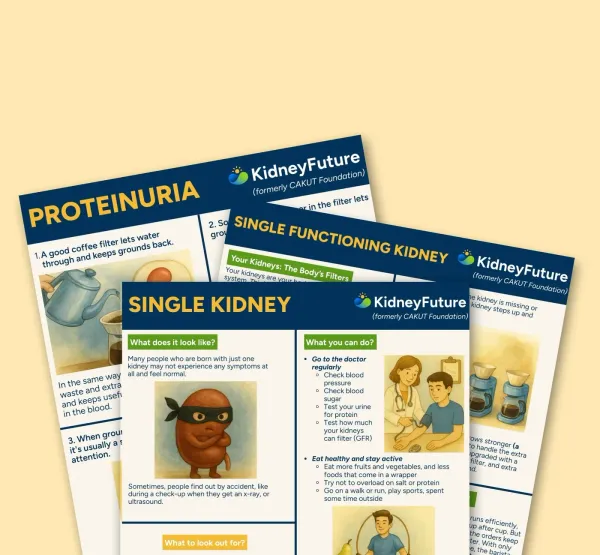 Download the full explainer (PDF)
The full text of both explainers is below, so you can read it here without downloading anything.
Proteinuria, explained
Proteinuria means protein is leaking into the urine. The easiest way to picture it is a coffee filter.
1. A good coffee filter lets water through and keeps grounds back.
In the same way, a healthy kidney lets waste and extra water (urine) through and keeps useful molecules like proteins in the blood.
2. Sometimes, a tiny tear in the filter lets grounds slip into the coffee.
Damage or stress to the tiny filtering vessels (glomeruli) of the kidney lets protein leak into urine. This leak is called proteinuria.
3. When grounds end up in the coffee, it's usually a sign the filter needs attention.
Protein in urine, measured as a ratio (uACR/uPCR), can signal issues in kidney function.
4. Grounds in your coffee don't just taste bad.
They clog the machine and scratch the filter, making new tears leading to more leaking. Leaked proteins can irritate and inflame the kidney's “pipes”, which speeds up damage and often complicates proteinuria further.
Single functioning kidney, explained
Your kidneys: the body's filters
Your kidneys are your body's built-in filtration system. Think of them as two coffee machines in a busy café. Each machine brews fresh coffee — like your clean, filtered blood — while holding back the coffee grounds, which represent waste and extra water that leave the body as urine.
When one kidney is missing or not working, the other steps up
The remaining kidney does the work of both. Little by little, it adapts and grows stronger (a process called hypertrophy) to handle the extra load — like a coffee machine upgraded with a bigger brew basket, a stronger filter, and extra features to keep up with demand.
What is single functioning kidney (SFK)?
Some individuals have only one working kidney. You can think of this like a café where one of the coffee machines can't help — whether it was never there, doesn't work properly, or had to be removed.
- Born with one kidney – Your doctor might call this renal agenesis.
- Born with two kidneys, but one doesn't work – This is known as renal dysplasia.
- Had a kidney removed for medical reasons – Such as cancer, serious injury, or donation; this is called a nephrectomy.
Effects of a single kidney
At first, it runs efficiently, brewing cup after cup. But over time, the orders keep coming faster. With only one machine, the barista might have to pour water through the filter more quickly (like high blood pressure) or deal with grounds piling up — like extra protein or waste in the blood (uremia).
The machine works harder than ever, but the extra strain can wear it down (hyperfiltration). Over time, it can't brew as smoothly, leaving more “grounds” — or waste — behind (proteinuria). With no backup, regular check-ups and care are essential.
These explainers are general information for families and are not a substitute for advice from your child's care team. Download the illustrated PDF to print or share.
More Topics On The Way
We're building out explainers for other common CAKUT-related terms families ask about, like hydronephrosis and vesicoureteral reflux. Tell us below what's confusing you right now, and we'll prioritize it.
What resource should we create next?
Tell us what resource or topic you want next and we'll prioritize it.
KidneyFuture is an official program of CAKUT Foundation Inc., a registered 501(c)(3) tax-exempt nonprofit organization (EIN: 39-3322233). We are dedicated to uniting families, clinicians, and researchers to transform outcomes for those born with kidney disease.
The information on this site is for general educational purposes only and is not medical advice. Always seek the advice of your physician or another qualified health provider with any questions about a medical condition.
Explore
Get Involved
Contact us
CAKUT Foundation Inc. (dba KidneyFuture)
1201 Seven Locks Rd, Ste 360, Rockville, MD 20854
Phone: +1 202-630-0043
Email: [email protected]
(c) 2026. CAKUT Foundation Inc. All Rights Reserved.